


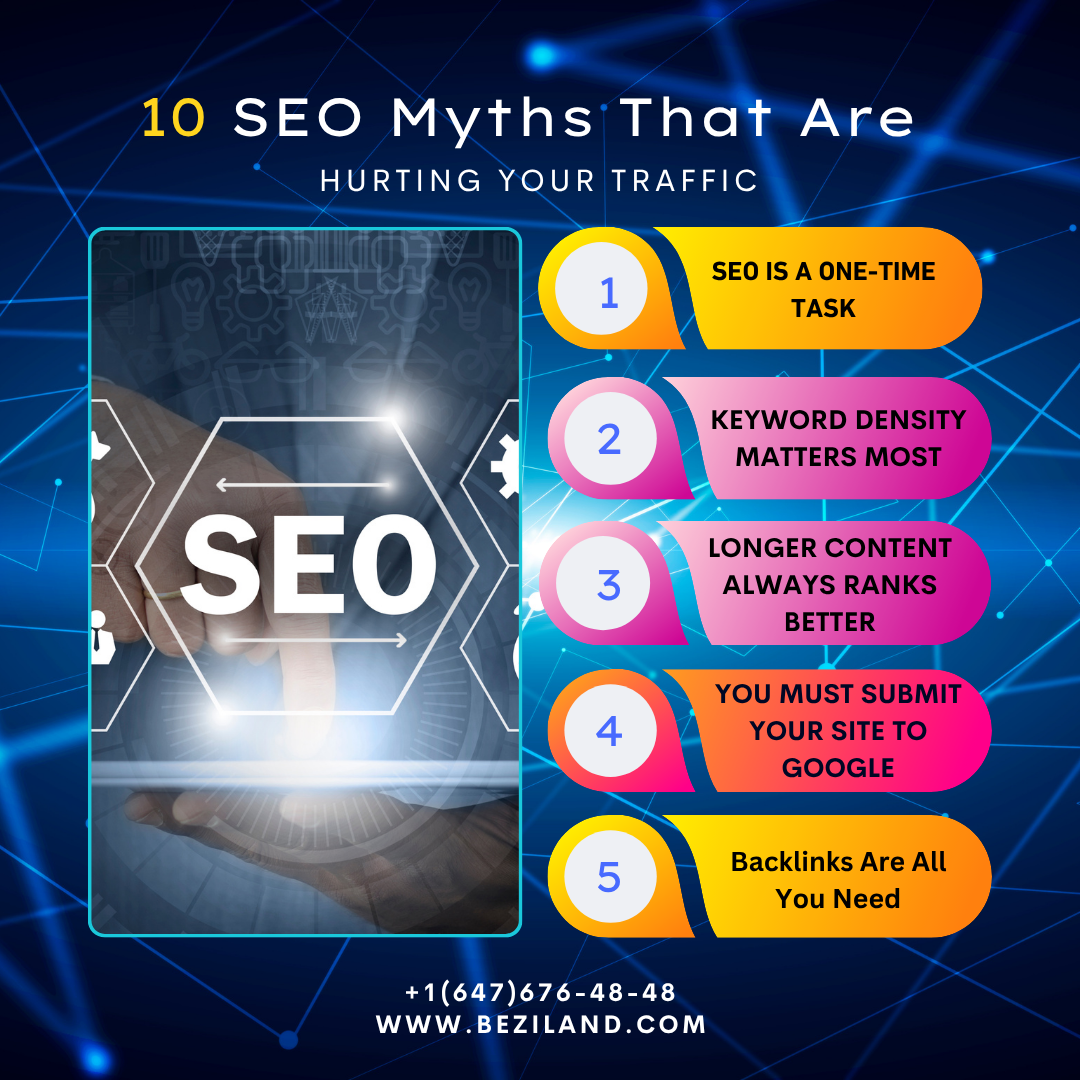
10 SEO Myths That Are Hurting Your Traffic
Table of Contents
10 SEO Myths That Are Hurting Your Traffic
Let’s bust some myths!
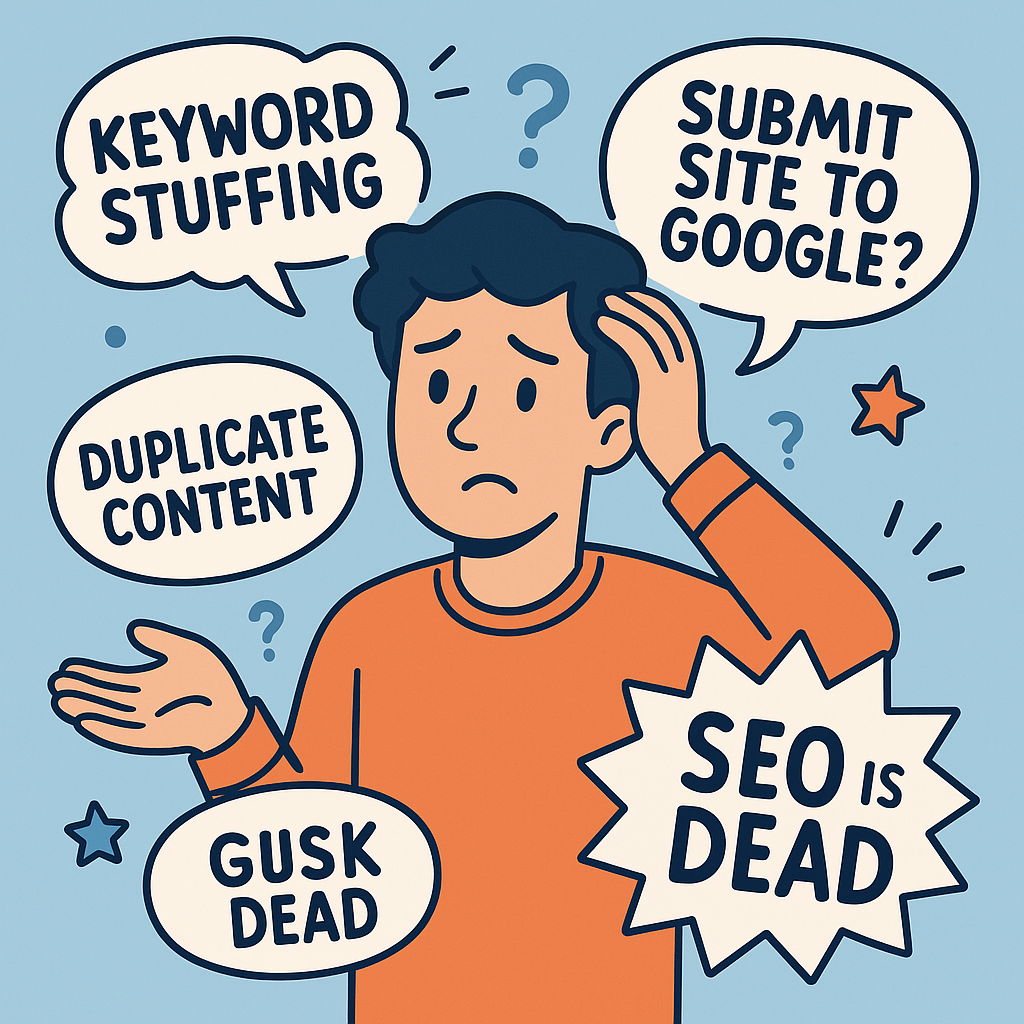
Myth 1: SEO Is a One-Time Task {#myth1}
Many people think SEO is something you do once—optimize your site, add a few keywords, and you’re done forever.
The truth: SEO is an ongoing process. Search algorithms evolve, competitors update their strategies, and user behavior changes. If you stop updating your content, your rankings will slowly decline.
What you should do instead:
-
Regularly update old blog posts.
-
Monitor your site’s performance with tools like Google Search Console.
-
Continuously build quality backlinks and improve user experience.

Myth 2: Keyword Density Matters Most {#myth2}
In the early days of SEO, stuffing a page with your target keyword could help you rank. Some people still cling to this outdated tactic.
The truth: Google’s AI now understands context, synonyms, and search intent. Overusing keywords can actually hurt your SEO by making content unnatural.
What you should do instead:
-
Write naturally for users, not just search engines.
-
Use semantic keywords and related terms.
-
Focus on answering the searcher’s question completely.
Myth 3: Longer Content Always Ranks Better {#myth3}
There’s a common belief that “the longer the blog post, the better it ranks.”
The truth: While long-form content often performs well, length alone isn’t a ranking factor. A 3,000-word article full of fluff won’t outrank a concise 800-word post that fully answers the query.
What you should do instead:
-
Write the right length for the topic.
-
Prioritize clarity, quality, and user experience over word count.
Myth 4: You Must Submit Your Site to Google {#myth4}
Many people still think they need to “submit” their site to Google for it to appear in search results.
The truth: Google’s bots automatically discover and index most websites. You only need to submit your sitemap if you want faster indexing or have a very new site.
What you should do instead:
-
Create a sitemap and submit it in Google Search Console.
-
Focus on building internal links to help bots crawl your site.
Myth 5: Backlinks Are All You Need {#myth5}
Yes, backlinks are important—but some believe they’re the only thing that matters.
The truth: Backlinks are just one of many ranking factors. A page with hundreds of low-quality links won’t rank better than a page with high-quality, relevant content.
What you should do instead:
-
Combine link-building with great content.
-
Earn backlinks naturally by creating valuable resources.
-
Avoid spammy link schemes—they can trigger Google penalties.
Myth 6: Social Media Doesn’t Affect SEO {#myth6}
“Google doesn’t count social signals, so social media doesn’t matter for SEO.”
The truth: While social shares aren’t a direct ranking factor, social media indirectly helps SEO. It drives traffic, increases brand awareness, and can lead to more backlinks.
What you should do instead:
-
Share your content on social platforms to reach a wider audience.
-
Build a community that engages with your content.
-
Encourage social sharing to amplify your reach.
Myth 7: Duplicate Content Will Kill Your Rankings {#myth7}
Duplicate content is widely misunderstood.
The truth: Google doesn’t penalize duplicate content unless it’s used maliciously (like scraping content). However, it may choose to rank only one version.
What you should do instead:
-
Use canonical tags if you have similar content across URLs.
-
Avoid copying large chunks of content from other websites.
-
Focus on unique, valuable content to stand out.
Myth 8: Exact Match Domains Guarantee Rankings {#myth8}
Some think buying a domain like bestcheaplaptops.com will automatically rank for “best cheap laptops.”
The truth: Exact match domains (EMDs) used to give an edge, but Google now focuses on content quality and user experience.
What you should do instead:
-
Choose a brandable, memorable domain.
-
Focus on building topical authority with great content.
Myth 9: Paid Ads Improve Organic Rankings {#myth9}
“If I run Google Ads, my organic rankings will improve.”
The truth: Google has stated repeatedly that paid ads do not influence organic search rankings. They are separate systems.
What you should do instead:
-
Use paid ads to supplement traffic, not manipulate SEO.
-
Focus on long-term organic strategies like content and links.
Myth 10: SEO Is Dead {#myth10}
Every time Google releases a major update, someone claims “SEO is dead.”
The truth: SEO is alive but constantly evolving. What worked in 2010 doesn’t necessarily work today. Instead of gaming algorithms, SEO now focuses on providing value and the best user experience.
What you should do instead:
-
Stay updated with the latest SEO best practices.
-
Adapt to new technologies like voice search and AI-driven search.
Conclusion & Call to Action {#conclusion}
The world of SEO is filled with outdated advice, half-truths, and myths that can derail your traffic growth. By focusing on quality content, user experience, and a sustainable SEO strategy, you’ll stay ahead of the competition.
✅ Key Takeaways:
-
SEO is a long-term, evolving strategy.
-
User intent > keyword stuffing.
-
Backlinks matter, but they’re not everything.
-
Social media, fresh content, and technical SEO all play a role.
Want better rankings without wasting time on SEO myths? Start with an SEO audit of your site and build a content plan that works for real users, not outdated tactics.
FAQ Section {#faq}
Q1: How long does SEO take to work?
SEO results typically take 3–6 months, depending on competition, content quality, and link-building efforts.
Q2: Should I focus on keywords or topics?
Focus on topics and search intent, not just individual keywords. Google understands context and relevance better now.
Q3: Are meta keywords still important?
No. Google no longer uses meta keywords as a ranking factor. Instead, focus on meta titles and descriptions for better click-through rates.
Q4: Can I do SEO myself or should I hire an expert?
You can start basic SEO yourself, but hiring an expert can help with technical SEO, advanced keyword research, and link-building strategies.
Q5: Does SEO work for small businesses?
Absolutely! Local SEO can help small businesses rank for nearby customers, bringing targeted traffic and leads.
Q6: How often should I update my website content?
Update your important pages every 6–12 months, or sooner if the information changes. Google loves fresh, accurate content.
Q7: Do Google updates always hurt SEO?
Not necessarily. Updates reward sites with good content and penalize low-quality or manipulative practices.
Q8: Should I prioritize mobile SEO?
Yes. Google uses mobile-first indexing, meaning it primarily evaluates the mobile version of your site.
Q9: What’s the #1 SEO ranking factor?
There isn’t just one. It’s a mix of quality content, backlinks, site speed, mobile optimization, and user engagement.
Q10: Is SEO worth it in 2025?
Yes! SEO continues to provide one of the best long-term returns on investment for online traffic.